

A miniature, gnarled fan of Madagascar's famous "elephant's foot" — the swollen caudex of a beloved dwarf pachypodium thrown into tangled, undulating crested growth, prized by collectors as a genuine botanical rarity.
Origin of Name
Pachypodium comes from the Greek pachys ("thick") and pous/podos ("foot"), a direct reference to the genus's swollen, water-storing caudex. The species rosulatum was described by John Gilbert Baker in 1882, its epithet nodding to the rosette ("rosula") of leaves clustered at each branch tip. The dwarf, rounder-caudexed form now known as gracilius — Latin for "slender," describing its finer branches and narrower leaves relative to the typical form — was first named as a variety by the French botanist Henri Perrier de la Bâthie in 1934, then raised to subspecies rank by Swiss botanist Urs Eggli's collaborator Hansjörg (Hans) Lüthy in 2004.
The "f. crest" designation refers to a recognised horticultural form, Pachypodium rosulatum subsp. gracilius f. cristatum — a fasciated mutation in which the growing tip loses its normal radial symmetry and instead extends into a flattened, ribbon-like band of tissue, folding into convoluted, fan-shaped mounds as it grows. This mutation arises spontaneously and unpredictably in cultivation rather than in the wild, which is part of what makes a well-formed crested specimen so sought after.
Origin of Plant
The typical (uncrested) subspecies gracilius is endemic to Madagascar, found only in the Isalo Massif of the south-central highlands, growing wedged into sandstone cliffs and escarpments between roughly 300 and 1,000 metres elevation alongside other rupicolous specialists such as Aloe isaloensis and Euphorbia isaloensis. Crested specimens like this one, however, are of garden origin — they arise as chance mutations on nursery-grown seedlings or grafts rather than being collected from the wild, meaning this plant's own "habitat" is the propagation bench, not the Isalo sandstone.
Description
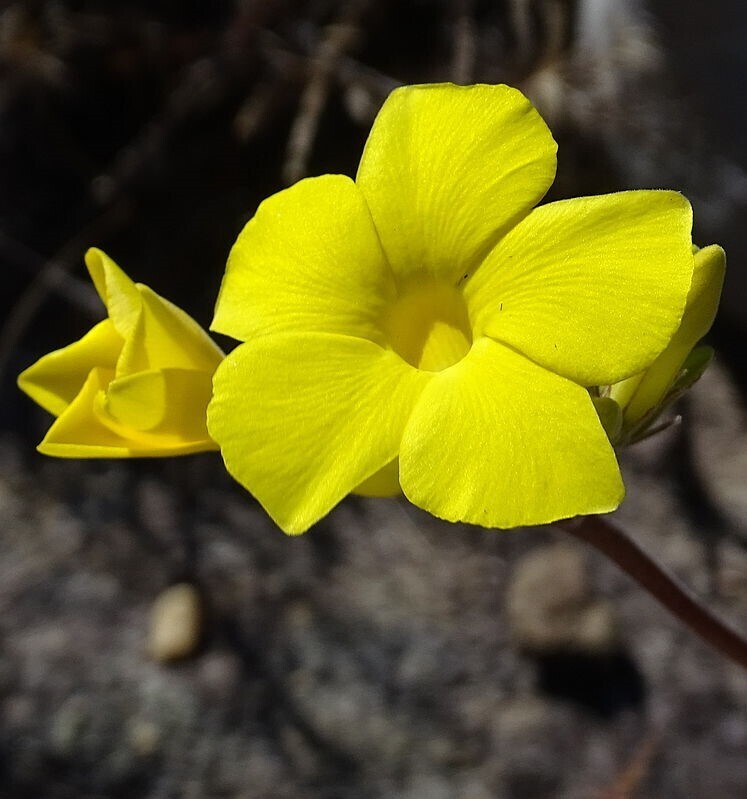
Where the standard form grows a smooth, rounded, silvery-grey caudex topped with slender spiny branches, the crested form abandons that architecture entirely: the stem tissue fans out into a thin, less than 1 cm-thick ribbon that folds and convolutes into a tangled, undulating mound up to around 40 cm across, reddish-brown and lightly spined with paired conical spines. Elliptic to lanceolate dark-green leaves, glossy above and paler beneath, emerge along the crest's ridges rather than at a single defined growing point. Mature specimens — crested or not — can produce clusters of two to five bright yellow, thin-tubed flowers on a long peduncle, though flowering is less reliable and often slower to begin on crested growth, which channels more energy into the mutated tissue itself.
Conservation Status
The genus Pachypodium is CITES-listed almost in its entirety: three Madagascan species (P. ambongense, P. baronii, P. decaryi) sit on Appendix I, while every other species — including P. rosulatum and all its subspecies — falls under Appendix II, meaning international trade requires proper permitting regardless of whether material is wild-collected or nursery-grown. Pachypodium rosulatum subsp. gracilius has not undergone a distinct, formal IUCN Red List assessment, though the wild Isalo population is considered under ongoing pressure from habitat disturbance and historical overcollection for the succulent trade. This crested specimen is entirely nursery-propagated, several generations removed from any wild plant.
Care
- Light: Full sun to very bright light — crested growth benefits from strong, even light on all sides of the fan to avoid lopsided development.
- Watering: Water moderately during the active spring–summer growing season, letting the soil dry out between waterings; reduce sharply and keep nearly dry once the plant drops its leaves and goes dormant in cooler months.
- Soil: A fast-draining, mineral-heavy succulent or cactus mix; good aeration around the root zone is essential to prevent rot.
- Temperature: A warm grower, best kept above 10°C (50°F); protect firmly from frost and cold, damp conditions, which this species tolerates far worse than heat.
- Feeding: A dilute, balanced fertiliser once or twice during the growing season supports steady, healthy crest development without pushing overly soft growth.
A Story Worth Telling
Crested pachypodiums occupy an odd, almost accidental corner of succulent history: unlike a species or even a named cultivar, a fasciated crest isn't bred or selected so much as found — a single seedling or cutting somewhere along the line simply mutates, and everything sold afterward is grown on from cuttings or grafts of that one aberrant individual. Because the mutation can't reliably be reproduced from seed, and because Pachypodium rosulatum subsp. gracilius was already a slow-growing, keenly collected dwarf species even in its normal form, a stable, well-shaped crest of it remains one of the rarer sights on any collector's shelf — a plant that is, quite literally, one of a kind multiplied.