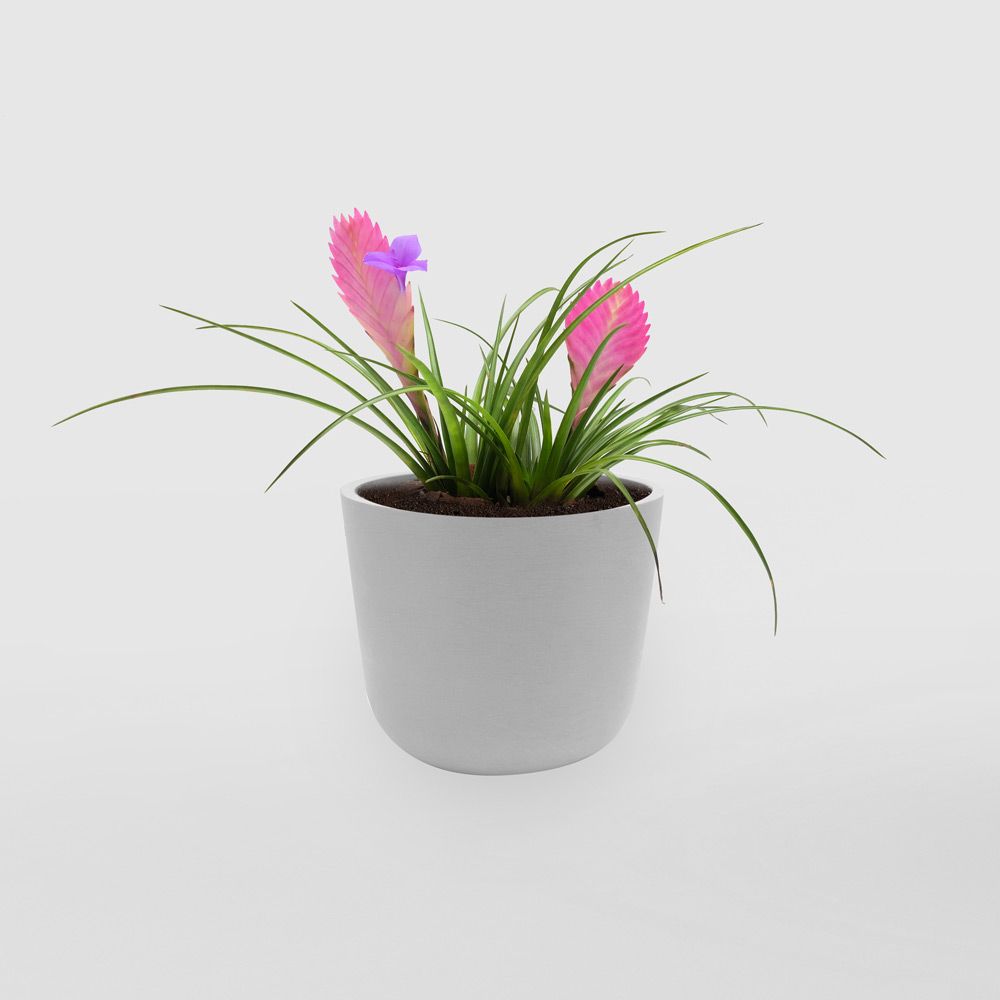
Introduce a splash of vibrant, exotic elegance into your home with the breathtaking Pink Quill, scientifically known as Wallisia cyanea (and formerly Tillandsia cyanea). This is no ordinary houseplant; it's a living work of art, featuring an astonishingly bright inflorescence that perfectly mimics a feathered quill. With its striking colors and captivating form, the Pink Quill promises to be an instant showstopper, bringing a touch of the Ecuadorian rainforest's magic right to your windowsill.
1. Origin of Name
The Pink Quill has a fascinating dual nomenclature that reflects ongoing botanical discovery. The older and more commonly recognized genus name, Tillandsia, honors Elias Tillandz (1640–1693), a Swedish physician and botanist known for his studies on Finnish flora. The specific epithet, cyanea, is Latin for "dark blue" or "cyan," a direct reference to the striking color of its actual, delicate flowers that emerge from the vibrant pink structure. More recently, taxonomic reclassification, based on molecular phylogenetic studies, has moved Tillandsia cyanea into the genus Wallisia, named after Gustav Wallis (1830–1878), a German plant collector and explorer who made significant contributions to the botanical world, particularly in South America. The common name "Pink Quill" perfectly encapsulates its most distinguishing feature: the flattened, paddle-shaped, intensely pink bract that gives the appearance of an ornamental feather.
2. Origin of Plant
Wallisia cyanea is a true native of the rainforests of Ecuador, specifically found in the cloud forests and mountain slopes. It typically grows as an epiphyte, attaching itself harmlessly to tree branches, or sometimes as a lithophyte, clinging to rocks. In its natural habitat, it thrives in environments characterized by high humidity, dappled light, and consistent moisture from fog and rainfall. Its discovery is part of the extensive botanical explorations of South America, which, particularly in the 19th and 20th centuries, revealed an immense diversity of bromeliads and other unique flora adapted to these lush, humid ecosystems.
3. Description
The Pink Quill is truly captivating, renowned for its dramatic and long-lasting inflorescence. It forms a rosette of narrow, arching, strap-like leaves, typically a vibrant green, often with subtle reddish or purplish tints when exposed to good light. The foliage typically spans about 20-30 cm (8-12 inches) wide. The plant's most striking feature is its flattened, paddle-shaped, sword-like inflorescence, which emerges from the center of the rosette. This bract is an intense, vivid shade of pink, coral, or reddish-pink, and can remain colorful for several months, gradually fading over time. From the edges of this spectacular pink "quill" emerge the actual flowers: small, delicate, violet-blue to deep purple blooms with three petals. These flowers appear sequentially, often lasting only a day or two each, but the continuous emergence over weeks adds a dynamic beauty to the overall display. The entire plant, including the inflorescence, can reach a height of 30-45 cm (12-18 inches).
4. Conservation Status
As a species, Wallisia cyanea (under its former Tillandsia cyanea classification) is generally considered to be of Least Concern on the IUCN Red List of Threatened Species. It is relatively widespread in its native Ecuadorian habitat, and its populations are not currently facing immediate, critical threats. However, like many rainforest species, localized populations can be vulnerable to habitat degradation due to deforestation, agricultural expansion, and climate change. Its widespread availability and popularity in cultivation significantly reduce any pressure on wild populations, making it a sustainable choice for plant enthusiasts.
5. Care
Despite its exotic appearance, the Pink Quill is surprisingly easy to care for, making it an excellent choice for indoor plant enthusiasts.
- Light: Provide bright, indirect light. It thrives in a location with good ambient light but should be protected from harsh, direct midday sun, which can scorch its leaves and fade the color of the bract. An east or west-facing window is often ideal.
- Watering: As an epiphyte, it appreciates humidity and consistent moisture but needs good air circulation to dry. Water by thoroughly soaking the plant (if potted in an open bark mix) or by misting the foliage and pouring clean, filtered water into the central cup formed by its leaves. Allow the potting medium to dry out completely between waterings. Do not let it sit in standing water. Use rainwater, distilled water, or filtered water if possible, as it is sensitive to chlorine and mineral salts. Reduce watering in winter.
- Potting Medium: If potted, use a very airy, fast-draining orchid bark mix, sphagnum moss, or a coarse bromeliad mix. It can also be grown mounted on cork bark or wood.
- Temperature: Prefers warm, stable temperatures, ideally between 18-28°C (65-82°F). Protect it from cold drafts and temperatures below 13°C (55°F), as it is not frost-tolerant.
- Humidity: High humidity is beneficial. Mist regularly, especially in dry indoor environments, or place it on a pebble tray with water, or near a humidifier.
- Tips: After the mother plant flowers, it will produce "pups" or offsets around its base. The mother plant will slowly decline after flowering (a natural process for many bromeliads), but these pups can be separated and grown into new plants. Fertilize sparingly (once a month during growing season) with a highly diluted (1/4 strength) bromeliad or orchid fertilizer, sprayed directly onto the leaves.
6. Engaging Anecdote
The Pink Quill's most charming anecdote lies in the clever deception employed by its vibrant pink bract. While the vivid pink structure is what catches our eye, these are not the plant's true flowers. Instead, they are highly modified leaves (bracts) that serve a vital purpose in its native rainforest: to attract pollinators. In the dense, green understory of the Ecuadorian cloud forest, the small, unassuming violet-blue flowers would easily be overlooked. But the brilliant, long-lasting pink "quill" acts as a beacon, drawing the attention of hummingbirds and insects that then delve deeper to find the actual nectar-rich blossoms. This spectacular display of advertising ensures the plant's successful reproduction in a competitive environment. So, when you admire your Pink Quill, remember that you're witnessing not just beauty, but a masterclass in botanical persuasion, a dazzling "billboard" of nature's own design.