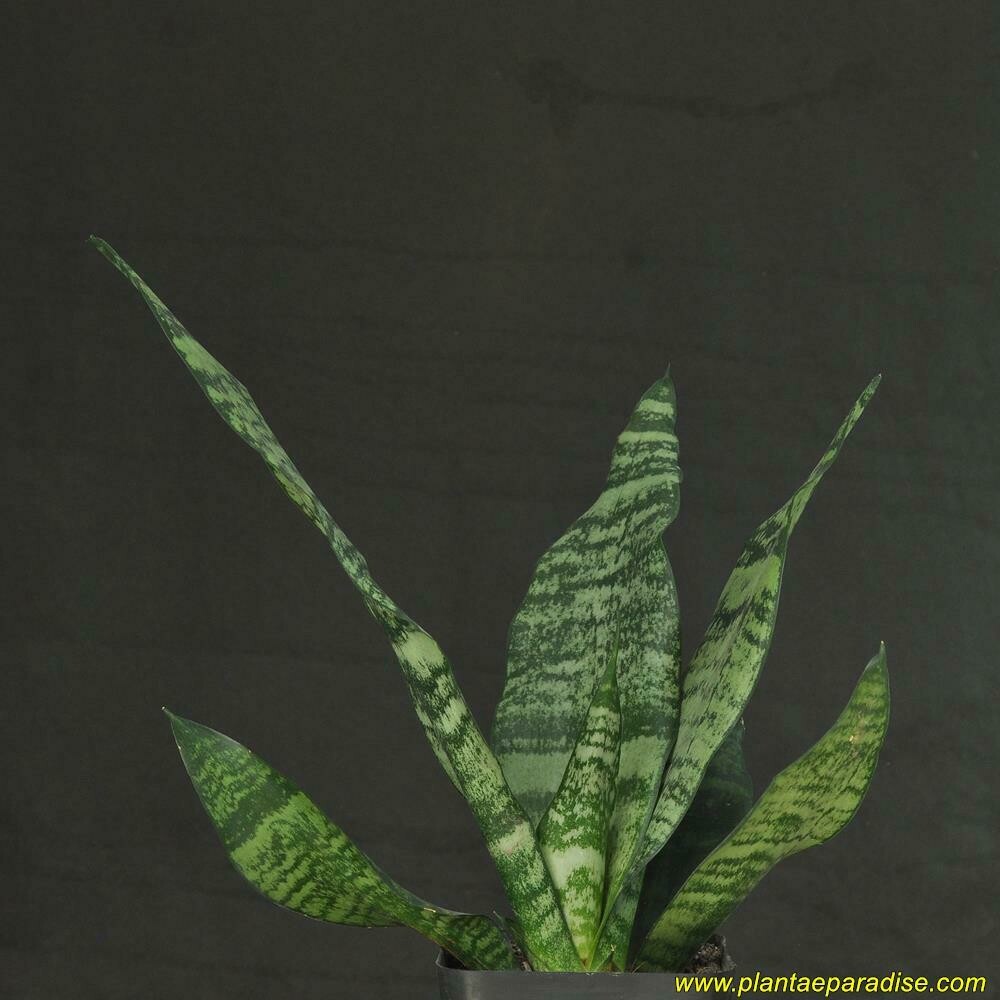
The classic snake plant in its true, wild-type form — stiff, upright, sword-shaped leaves in dark green with pale gray-green tiger-stripe banding, as tough and unfussy as houseplants get.
Origin of Name
The genus name Sansevieria carries a tangled history. It's generally said to honor Raimondo di Sangro, Prince of San Severo, an 18th-century Italian nobleman and inventor — though the more precise story credits Italian botanist Vincenzo Petagna, who in 1787 coined the related name "Sanseverinia" for a different patron, Pietro Antonio Sanseverino, Count of Chiaramonte, in whose garden Petagna had studied the plant. When Swedish botanist Carl Peter Thunberg published "Sansevieria" in 1794, it's unclear whether he deliberately renamed the genus or simply misspelled Petagna's version — but Thunberg's spelling is the one that stuck, and "Sansevieria" remains the name most growers use to this day.
The species itself has an equally winding paper trail. Carl Linnaeus first lumped it in with Aloe in 1753, before Scottish botanist David Prain formally described it as Sansevieria trifasciata in 1903. The epithet trifasciata is Latin for "with three bands" or "three bundles," a nod to the pale cross-banding that runs in irregular stripes across each dark green leaf. In 2017, DNA studies revealed that Sansevieria actually sits nested within Dracaena (the dragon tree genus, from Greek drakaina, "female dragon"), and botanists folded some seventy Sansevieria species into Dracaena — making this plant's current accepted name Dracaena trifasciata, even though "Sansevieria trifasciata" remains firmly the name it's sold under. Its many common names tell their own story: "snake plant" for the leaf shape, "mother-in-law's tongue" for the sharp pointed tips, "Saint George's sword" in Brazil, and "viper's bowstring hemp" for a much older, practical use — its tough fibers were once stripped and twisted into bowstrings and rope.
Origin of Plant
Sansevieria trifasciata is native to tropical West and West Central Africa, found growing wild from Nigeria eastward across the Congo basin. In the wild it grows in rocky, dry, often shaded ground beneath forest canopy or scrub, spreading slowly via tough underground rhizomes — the same rhizomes that let a single plant colonize a wide patch of ground over time. Its striped leaf pattern, so recognizable as a houseplant, actually serves as camouflage against the dappled light of its native habitat.
Description
The plant forms a tight, upright rosette of stiff, blade-like leaves rising almost vertically from the soil, with no visible stem. Each leaf is dark green, mottled with irregular pale gray-green cross-banding, tapering to a sharp point at the tip — mature leaves typically reach 70–90 cm in length and 5–6 cm across, though under good conditions they can grow considerably taller. New leaves emerge continuously from spreading rhizomes, so a healthy plant slowly widens its rosette over the years. Given enough light and maturity, it can send up a slender flower spike bearing clusters of small, greenish-white to cream tubular flowers, sticky to the touch and often fragrant at night — though flowering indoors is uncommon and something of a treat when it happens.
Conservation Status
Sansevieria trifasciata is not considered threatened — it grows across a wide range spanning multiple West and Central African countries and has not been formally assessed as at-risk on the IUCN Red List. If anything, the concern runs the other way: in parts of tropical Australia and Brazil, escaped garden plants have naturalized so successfully that the species is flagged as a potential weed. As a houseplant, it's propagated almost entirely from rhizome divisions and offsets rather than wild collection, so buying one has no bearing on any wild population.
Care
Light: Extremely adaptable — tolerates low light better than almost any houseplant, though it grows fuller and faster in bright, indirect light. Avoid intense, prolonged direct sun, which can scorch the leaves.
Watering: Let the soil dry out completely between waterings, then water thoroughly — roughly every 2–3 weeks in the growing season and far less in winter, sometimes just once every month or two. Overwatering, not underwatering, is what kills this plant.
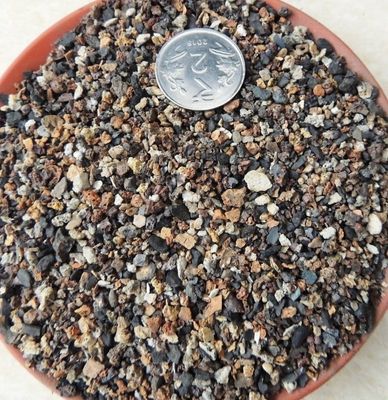
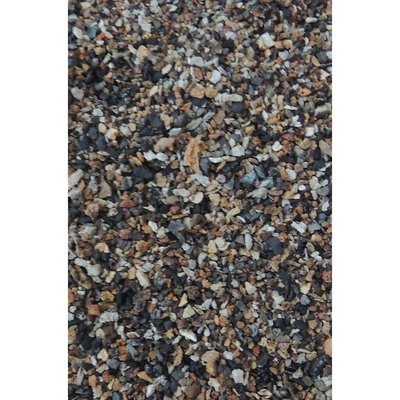
Soil: A fast-draining potting mix, ideally a cactus or succulent blend, or ordinary potting soil cut with extra perlite or coarse sand.
Temperature: Comfortable in typical indoor conditions between about 15–30°C (60–86°F); protect from cold drafts and temperatures below 10°C (50°F).
General tips: Feed sparingly, once or twice during the growing season, with a diluted balanced fertilizer — this plant thrives on neglect rather than attention. Divide congested clumps at the rhizome to propagate true-to-type; leaf cuttings will root but lose any variegation. Note the leaves contain mildly toxic saponins, so keep them out of reach of pets prone to chewing houseplants.
An Interesting Note
This unassuming plant has quietly turned up in some unexpected places. NASA's 1989 Clean Air Study listed it among species capable of filtering common indoor air pollutants, a finding that snowballed into its enduring reputation as a "natural air purifier," even though later research suggests the effect is far too slow to meaningfully change air quality in a real room. It has also made a cameo in American art history — a snake plant sits on the porch in Grant Wood's 1930 painting American Gothic. And in parts of Nigeria and Brazil, it's grown not just for looks but for protection: associated with the orisha Ògún, it's planted by doorways to ward off the evil eye, known in Brazil as espada de São Jorge, Saint George's sword.