Stars of the Genus — An All-Astrophytum Eight
A single-genus deep dive for the true completist: eight Astrophytum — the "star cacti" — spanning every hallmark trait the genus is known for. Wild, unkempt goat's-horn spines sit beside spineless, heavily flecked Japanese show cultivars; a wild-type sand dollar sits beside one of the most famous man-made mutations in the hobby. It's less a random assortment than a compact tour of what a hundred-plus years of collecting and breeding has done to one small genus of Mexican and Texan stars.
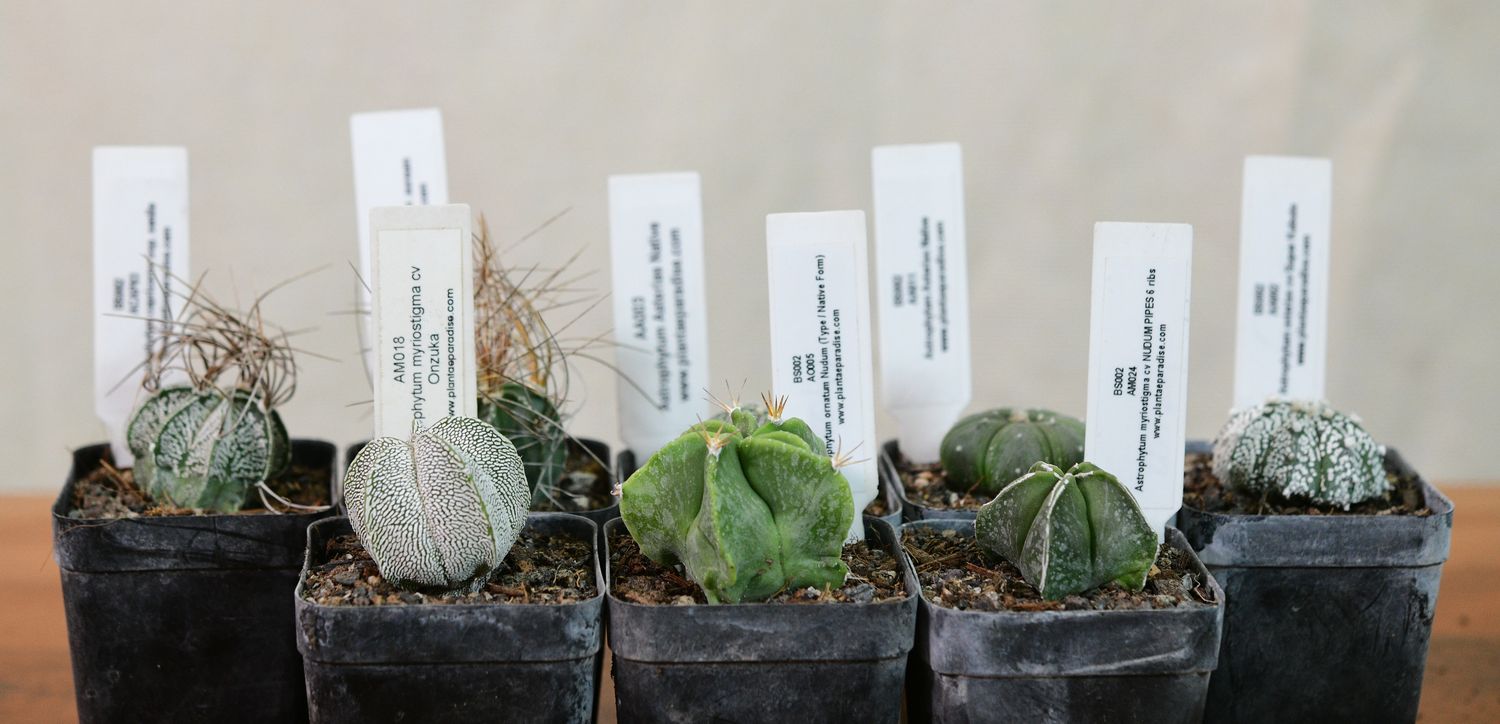
1. Astrophytum capricorne ssp. senile — Goat's Horn Cactus Named for its "old man" look: soft, flexible spines up to 10 cm long emerge in such profusion, spiralling in every direction, that the green body beneath all but disappears — resembling, as growers often put it, a loose bundle of dry grass. Given a few years, it opens large, showy yellow-to-orange flowers with a red centre.
2. Astrophytum capricorne var. aureum The golden-spined form of the goat's horn cactus — young spines emerge a striking metallic gold before greying with age, on the same long, curling, horn-like spination that gives the species its name (from the Latin capricornus, "goat-horned"). A slow but rewarding grower from the deserts of Coahuila, Mexico.
3–4. Astrophytum asterias — Native form (two specimens) The true "sand dollar" or "sea urchin" cactus: a flattened, spineless disc marked with small white speckles, native to a narrow strip of Texas and northern Mexico where habitat loss has left the wild population endangered — making a nursery-propagated seedling like this one a genuinely meaningful way to grow the species. In season it opens glossy yellow flowers with a red-orange throat.
5. Astrophytum asterias cv. Super Kabuto One of the most famous cactus cultivars in existence, tracing back to a single mutant plant found in an American garden centre in 1981 by Japanese collector Masaomi Takeo and sold on to Tony Sato in Japan. Every "Super Kabuto" alive today descends from that one find — its dense, snow-white mosaic of trichome spots (named for the kabuto, a samurai helmet) is so heavy it can look as though the plant has been dusted in paint.
6. Astrophytum myriostigma cv. Onzuka Bred almost by accident in Hiroshima, Japan around 1974–77 by Mr. Tsutomu Onzuka, who was attempting to cross a three-ribbed myriostigma with the spotless "nudum" form — and instead produced, after several generations of backcrossing, an unexpected cultivar blanketed in fabulous, ever-changing white markings. Widely considered the single most sought-after myriostigma cultivar in cultivation.
7. Astrophytum ornatum "Nudum" (Type/Native form) The giant of the genus in the wild — A. ornatum can eventually reach two metres tall in habitat — represented here in its youthful "nudum" form, with a stout, dark green, largely unflecked stem quite different from the broad white-banded ribs of the typical form. Native to canyon walls and limestone cliffs in Hidalgo, Querétaro, and Guanajuato, Mexico.
8. Astrophytum myriostigma cv. "Nudum Pipes" (6 ribs) A six-ribbed strain of the spineless, largely flake-free "nudum" myriostigma line — a deviation from the usual five ribs that collectors prize when it holds stable with age. "Pipes" appears to be a grower-given strain name rather than a formally published cultivar, so we're noting that honestly rather than inventing a backstory for it; what's certain is the smooth, softly banded green body typical of nudum-type myriostigmas underneath.