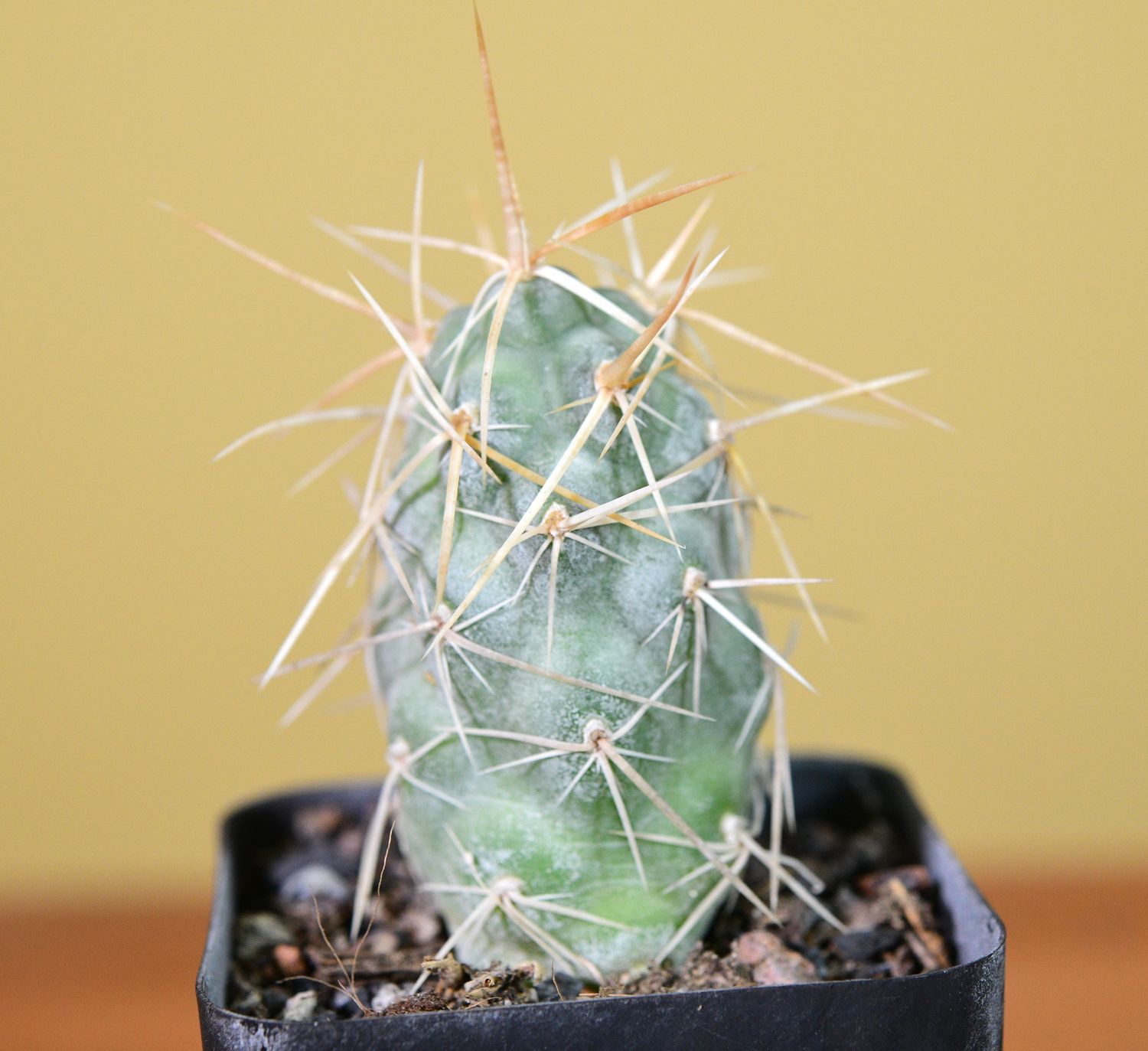
Some cacti hide behind their spines; this one performs with them. Broad, bone-white blades radiate from a squat green body like a startled sea urchin, each one flattened, papery, and utterly disproportionate to the small plant beneath — a wide-spined form of the Paper Spine Cactus, collected from the arid hill country of La Rioja and prized by collectors precisely for spines this exaggerated.
Origin of Name
The genus Tephrocactus comes from the Greek tephra, "ash," describing the pale, ash-grey cast typical of the group's stems. The species name articulatus is Latin for "jointed," a reference to the loosely stacked, easily separated segments that make up the plant's body. The variety name papyracanthus — from the Latin papyrus (paper) and Greek akantha (thorn) — was coined for the plant's most singular trait: spines that are not needle-like at all, but flattened, dry, and papery, closer in texture to raffia or parchment than to any conventional cactus armament.
This particular plant carries the descriptor "widespinus," a designation used among specialist growers rather than a formally published botanical name, applied to broad-spined field forms of papyracanthus in which the flattened spines grow noticeably wider than the typical straw-thin norm. The accompanying field code and locality data (Villa Mervil, La Rioja) trace this particular clone back to a specific wild- population, a common and valued practice in the Tephrocactus world, where individual habitat populations can differ meaningfully in spine width, colour, and form even within a single named species.
Origin of Plant
Tephrocactus articulatus is native to the arid, high-altitude scrublands of northwestern and north-central Argentina, occurring across the provinces of Catamarca, Córdoba, La Rioja, Mendoza, Salta, San Luis, and Santiago del Estero. This particular form hails from the La Rioja region specifically, where the species grows on poor, stony, fast-draining ground in prepuna and Andean foothill habitat — a landscape of bone-dry winters, brief sparse summer rains, and extreme swings between day and night temperature. It is exactly this harsh, exposed terrain that has favoured wide, reflective spination as a form of sun protection.
Description
The stem grows as a loose chain of small, rounded to pinecone-shaped segments, each carrying prominent tubercles and a smooth, green to grey-green skin. As with all forms of this species, the segments attach only tenuously to one another and detach readily at the joints. What distinguishes this wide-spined form is its spination: broad, flattened, papery blades — pale cream to golden-brown, some tipped in warmer rust tones — erupting from the areoles in long, splayed arcs that can dwarf the stem segment itself. Where the standard form produces fine, straw-like spines, this one produces something closer to ribbons or shavings, catching and scattering light in a way few other cacti can match. Given a proper cool winter rest, mature plants may produce funnel-shaped white flowers with soft yellow centers from the areoles near the growing tips, though blooming in cultivation is an occasional event rather than a guarantee.
Conservation Status
As a member of the family Cactaceae, this species is listed under CITES Appendix II, which regulates international trade to protect wild Argentine populations from over-collection. This specimen, propagated in cultivation, falls outside the trade restrictions aimed at wild-collected material, allowing collectors to enjoy this striking wide-spined form without drawing on habitat populations.
Care
- Light: Full sun encourages the tightest growth and the boldest spine development; in very intense climates, light afternoon shade prevents scorching.
- Watering: Water generously through the growing season, letting the soil dry out completely between each watering; reduce sharply in winter, keeping the plant nearly dry during its rest period.
- Soil: A gritty, fast-draining mineral mix — heavy on pumice, coarse sand, or perlite — is essential to prevent rot.
- Pot: Terracotta is preferred over plastic, as it helps excess moisture evaporate rather than linger around the roots.
- Temperature: Tolerant of cool conditions and brief light frost once well established and kept dry, though prolonged cold combined with damp soil poses a far greater risk than the cold itself.
- Feeding: Apply a light, low-nitrogen, high-potassium cactus fertiliser sparingly, once or twice during the growing season.
A Story Worth Telling
Field-collected forms like this one are part of a long tradition among Tephrocactus enthusiasts, who have spent decades trekking through the stony hills of La Rioja, Catamarca, and San Juan documenting just how wildly this single species can vary from one hillside to the next — fine spines here, broad ribbons there, spineless forms a few kilometres further on. Each locality tends to produce its own subtly distinct look, and growers prize wide-spined forms like this one precisely because that exaggerated, sculptural spination rarely shows up twice in quite the same way. Owning a plant with a recorded field origin is, in a small way, owning a fragment of that mapped variation — a single documented point in a species that seems determined never to look the same way twice.