

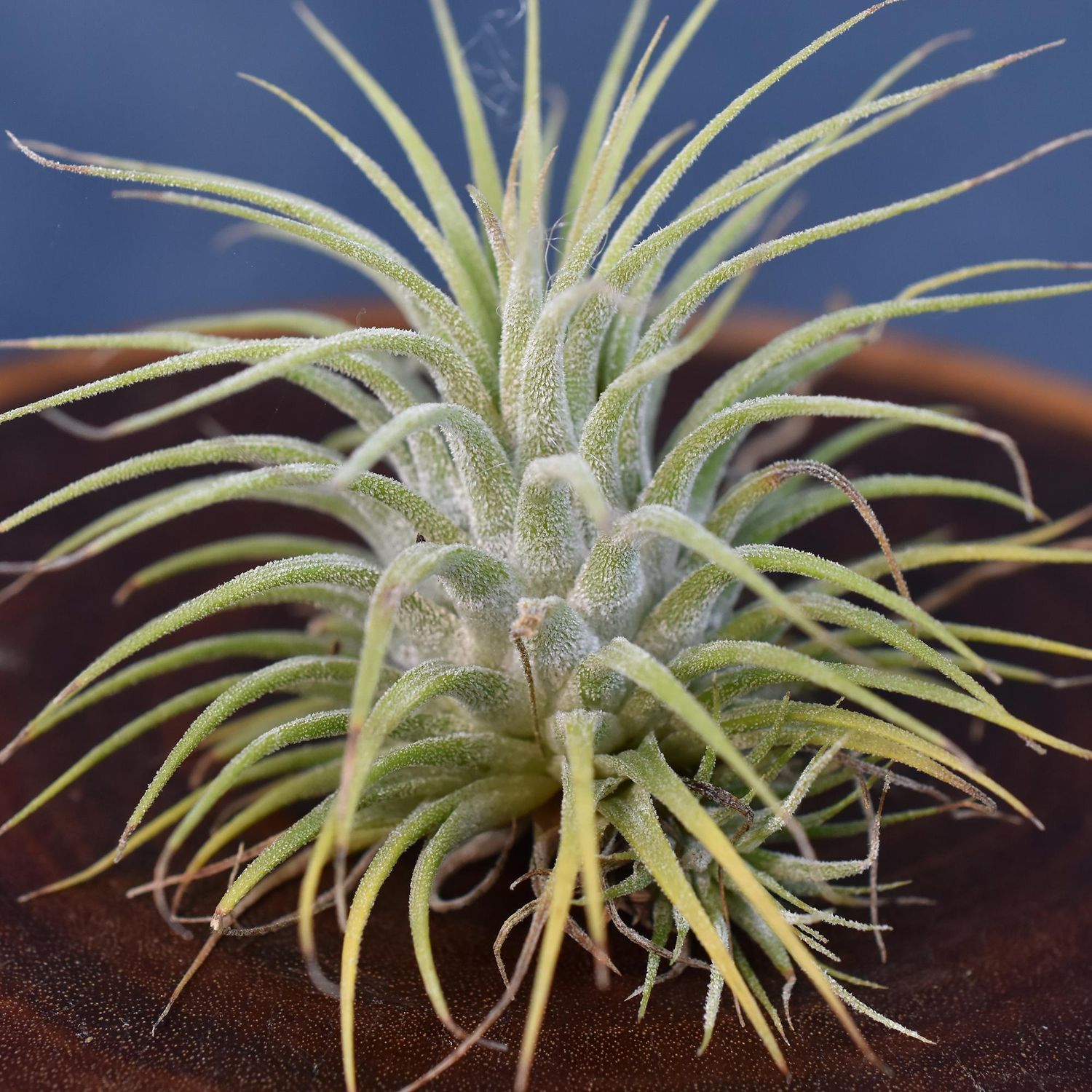
Tillandsia inonanatha stricta
Product Details
Vertical Geometry: Tillandsia ionantha 'Stricta'
An architectural marvel of the Bromeliad family, this cultivar transforms from a silver-green spire into a vivid crimson beacon during its bloom cycle.
- Origin & History of Name: The genus Tillandsia was named by Carl Linnaeus in 1738 to honor the Swedish physician and botanist Elias Tillandz.
- Morphology: This epiphyte is characterized by its caulescent (stem-forming) tendency and densely packed, succulent leaves. The epidermis is covered in specialized scales called trichomes, which serve as the plant's primary organs for water and nutrient absorption. Unlike the spreading rosette of the type species, 'Stricta' maintains a compact, vertical silhouette. Upon maturity, the inner foliage undergoes a chromatic shift, turning deep red to attract pollinators.
- Habitat & Origin: While the base species is native to the xeric (dry) forests of Central America and Mexico, 'Stricta' is a specialized cultivar selected for its upright form. It is produced via vegetative offsets (pups) in controlled nursery environments. This ensures a sustainable supply chain that protects wild populations from illegal poaching and habitat loss.
- Cultivation Profile:
- Substrate: As an atmospheric epiphyte, it requires no soil.
- Light: Thrives in bright, filtered sunlight. In the Indian subcontinent, provide 50% shade cloth protection during the harsh summer months (April–June) to prevent foliar burn, especially in inland cities like Delhi or Hyderabad.
- Water/Dormancy: Mist heavily 3–4 times a week or perform a 20-minute submersion once weekly. In high-humidity coastal regions like Mumbai or Chennai, ensure rapid drying within 4 hours to prevent "crown rot." It does not have a true dormancy but slows growth during the cooler winter months.
- Substrate: As an atmospheric epiphyte, it requires no soil.
- Scientific/Historical Anecdote: Tillandsia species are pioneers of CAM (Crassulacean Acid Metabolism) photosynthesis. Unlike most plants, they keep their stomata closed during the blistering day to conserve moisture and only "breathe" at night.
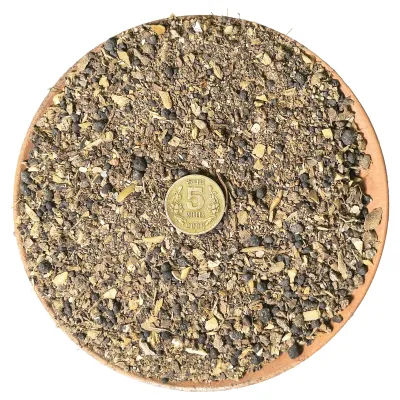
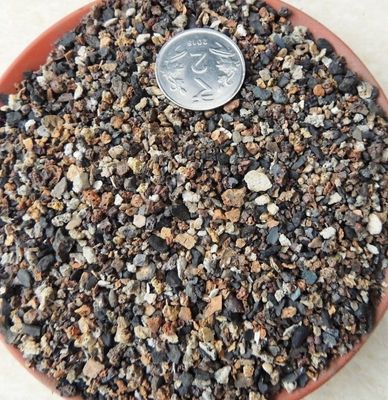
Cactus & Succulent Planting Mix FINE (aka Cactus Soil Mix or Succulent Soil Mix)
Cactus & Succulent Planting Mix FINE (aka Cactus Soil Mix or Succulent Soil Mix)
Fine-Grain Potting Mix for Cactus & Succulent Roots
SKU MNS001
₹33.74
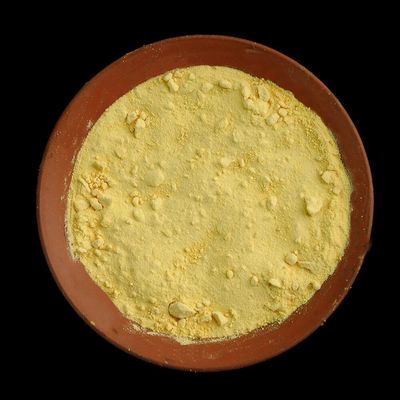
Soya Power Pack Amino acid Soya based 80% purity 800gm
Soya Power Pack Amino acid Soya based 80% purity 800gm
Premium Soya-Based Amino Acid Plant Booster for Stronger Roots, Greener Growth & Stress-Resistant Plants
SKU MNS009
₹315.00
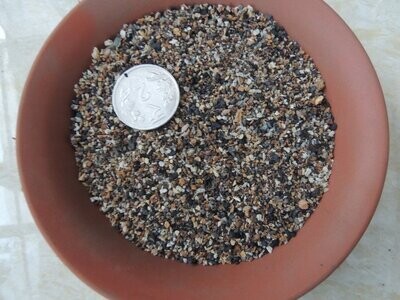
Cactus Seed Planting Mix
Cactus Seed Planting Mix
Sterile, Fine-Grain Media for Cactus & Succulent Seeds
SKU MNS005
₹66.35