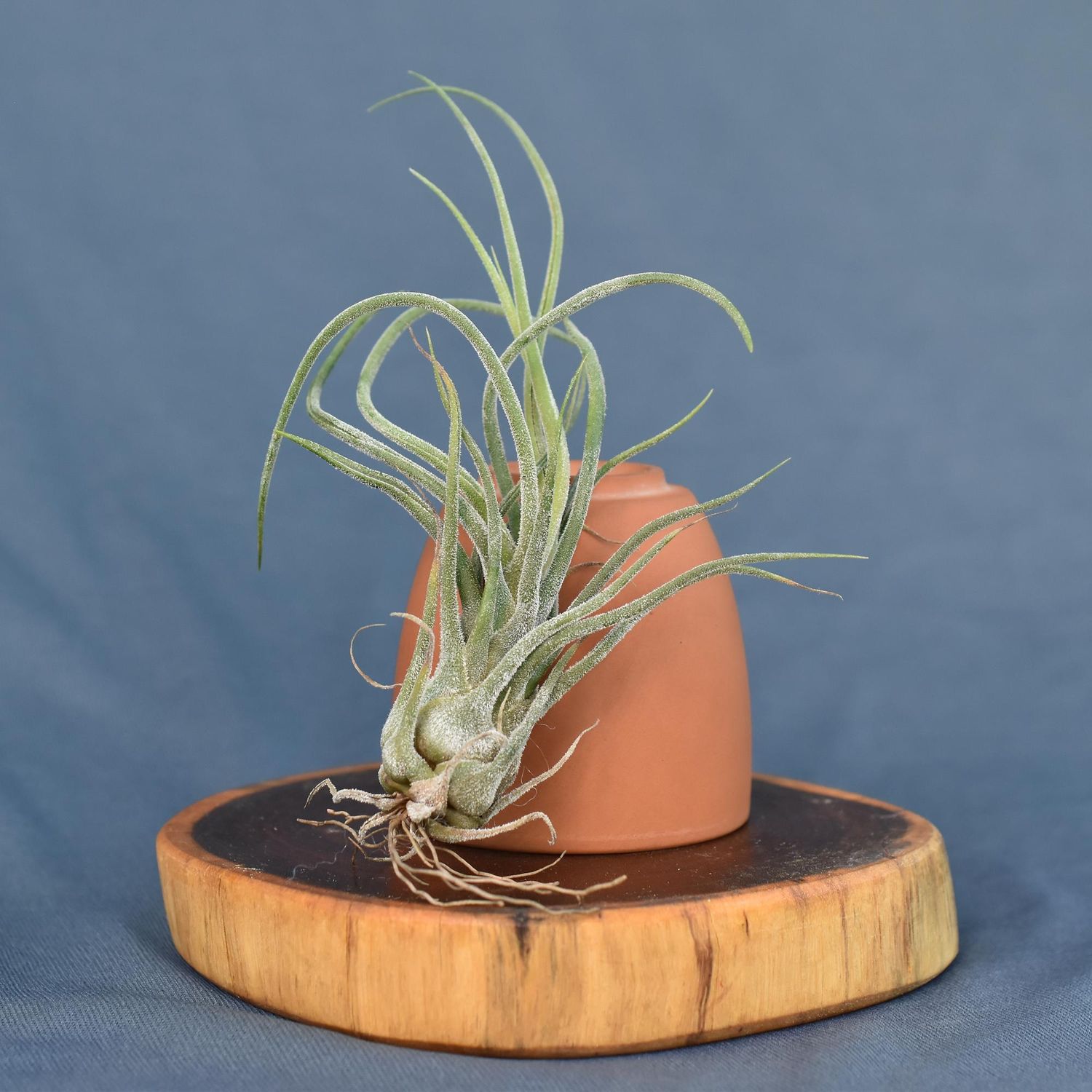
Tillandsia pruinosa
Product Details
Frosted Extremophile: Tillandsia pruinosa
Possessing a distinct velvety silver sheen, this xeric bromeliad is a masterpiece of specialized atmospheric evolution.
- Origin & History of Name: The genus Tillandsia was named by Carl Linnaeus in 1738 to honor the Swedish botanist and physician Elias Tillandz.
- Morphology: Tillandsia pruinosa is a pseudobulbous epiphyte characterized by a swollen base and twisting, channeled leaves.
- Habitat & Origin: This is a wild species with a broad natural range extending from Florida and the Caribbean through Central America into South America.
- Cultivation Profile:
- Substrate: Strictly non-terrestrial. It should be mounted on cork bark, driftwood, or suspended in the air using wire. Do not plant in soil or pots, as the bulbous base is highly susceptible to rot.
- Light: Requires bright, filtered light. In India, it thrives near north- or east-facing windows. Avoid direct midday sun during Indian summers, which can scorch the delicate trichome layer.
- Water/Dormancy: Mist 3–4 times weekly or provide a 20-minute soak once a week. In the high humidity of the Indian monsoon, reduce frequency. Ensure the plant dries completely within 4 hours; stagnant water trapped in the pseudobulb will cause rapid decay.
- Scientific/Historical Anecdote: Tillandsia pruinosa utilizes CAM (Crassulacean Acid Metabolism) photosynthesis. To conserve water in its often-exposed arboreal environment, the plant keeps its stomata closed during the blistering day and "breathes" (exchanges gases) only at night. This efficiency allows it to survive in micro-climates where other vegetation would quickly dehydrate.
New
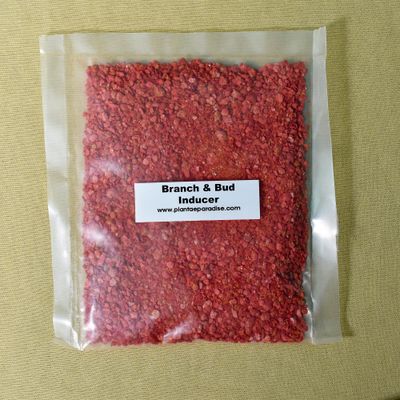
Branch & Bud Inducer 200gm
Branch & Bud Inducer 200gm
Flowering Booster for Plants | Branch & Bud Inducer
SKU MNS018
₹355.00
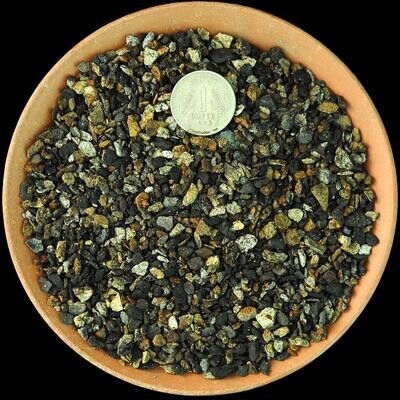
Cactus & Succulent Planting Mix COARSE (aka Cactus Soil Mix or Succulent Soil Mix)
Cactus & Succulent Planting Mix COARSE (aka Cactus Soil Mix or Succulent Soil Mix)
Washed, Free-Draining Mineral Mix for Cactus & Succulents
SKU MNS003
₹38.74