Trichocereus hybrid 'Snow White'
A pure, luminous flower to match its name, 'Snow White' opens into a wide, star-shaped bloom of snow-white petals brushed with soft coral-pink at their tips, framing a golden-green throat crowded with amber stamens and a pale, radiating stigma. Carried on a ribbed, spine-studded column typical of the great South American torch cacti, it's the kind of flower that turns an otherwise quiet, thorny plant into the centerpiece of a collection for the day it chooses to bloom.
Origin of Name
'Snow White' is a trade or cultivar name rather than a formally registered botanical one, and — as with many hybrids that pass between growers and nurseries rather than through published breeding institutions — its exact coining story isn't part of any public record. The name itself needs little explanation: it describes exactly what the flower delivers, a broad, brilliantly white bloom pure enough in color to earn the same name as the fairy-tale heroine known, in the Brothers Grimm's original telling, for skin "as white as snow." It's a naming convention cactus growers reach for constantly — pairing a plain, evocative English name to a flower's most obvious trait — and in this case the trait is simply undeniable.
The genus name attached to it, Trichocereus, has a much older and better-documented history. It combines the Greek thrix / trichos ("hair") with the Latin cereus ("wax candle" or "torch"), a reference both to the tall, ribbed, torch-like columns these cacti form and to the tufts of wool or hair often found in their areoles. The name was first proposed in 1905 by the German botanist Alwin Berger as a subgenus of Cereus, then raised to full genus status in 1909 by the Italian botanist Vincenzo Riccobono. For most of the 20th century, Trichocereus stood as its own genus of tall, columnar South American cacti prized above all for their enormous, fragrant, often white flowers. In 1974, botanist Herbert Friedrich showed that Trichocereus flowers shared the same essential structure as those of the globular genus Echinopsis — a spineless but hairy floral tube, an open nectar chamber, and stamens arranged in two distinct series — and argued the two should be merged. That reclassification is now widely followed, and Trichocereus is generally treated today as a synonym of Echinopsis, though the name remains in everyday use among growers and nurseries, especially for the tall, columnar, large-flowered hybrids like this one.
Origin of Plant
As a hybrid or selected cultivar, 'Snow White' has no wild habitat of its own — it is a garden-raised plant, not one collected from nature. Its genetic background, though, traces to the columnar "torch cacti" native to South America, spanning Argentina, Bolivia, Peru, Chile, Brazil, Uruguay, and Paraguay, where wild Trichocereus/Echinopsis relatives grow as tall, branching columns or clustering clumps across deserts, scrubland, and rocky Andean foothills, some at considerable elevation. These wild ancestors are known for producing some of the largest and most fragrant flowers in the entire cactus family, typically pure white or white flushed with pink, opening at dusk and closing again by the following morning — a strategy built around long-tongued, night-flying hawkmoths as pollinators, for whom a large pale flower glowing in the dark is an easy target to find. Generations of hybridizers, working with this wild gene pool since at least the early 20th century — building on pioneering work by figures such as Harry Johnson and later specialists including Robert Schick — have crossed and selected among these columnar species to refine flower size, color purity, and plant habit, producing garden-friendly cultivars like this one.
Description
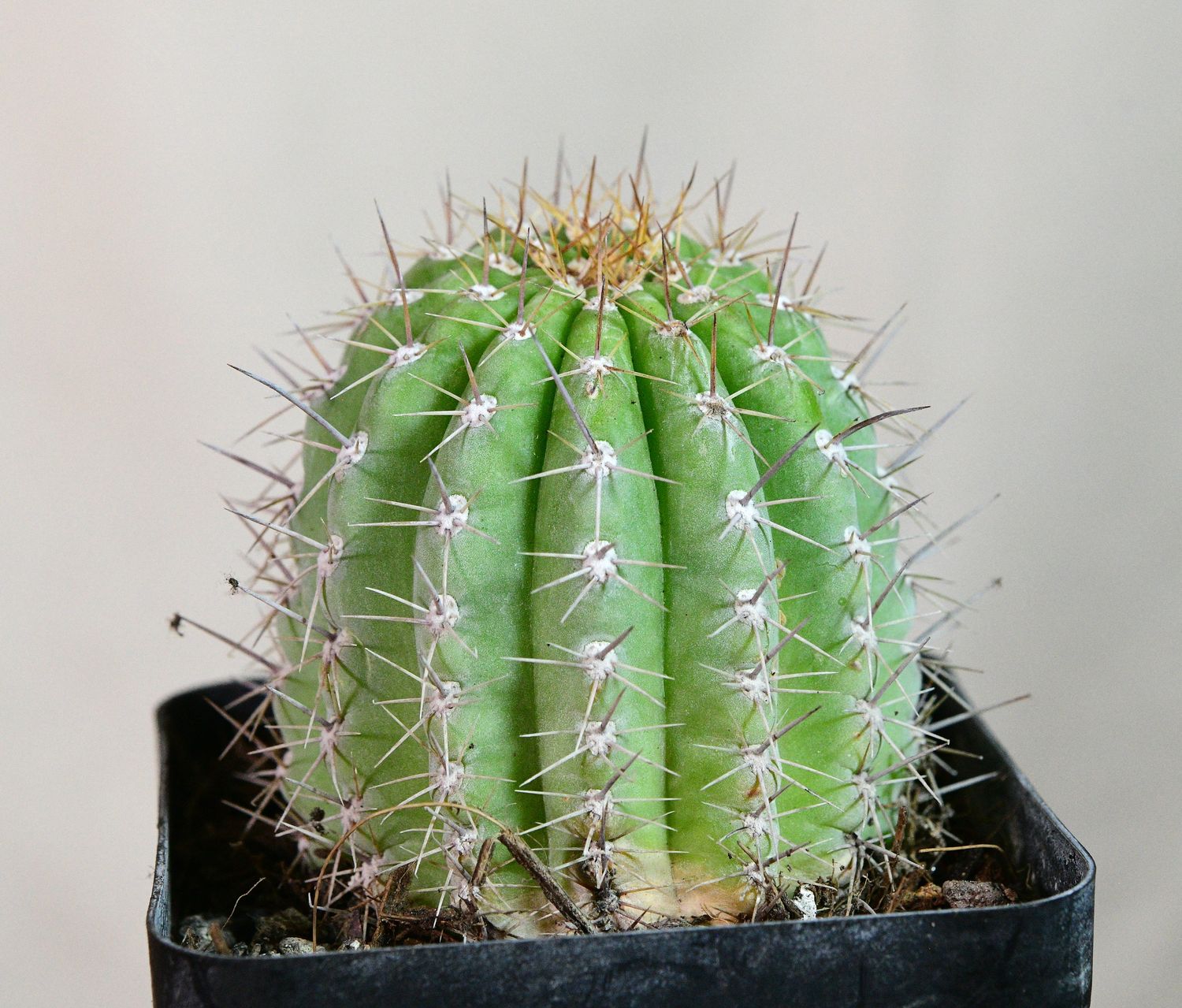
'Snow White' grows as an upright, ribbed, columnar stem, deep green and clearly veined with vertical ribs that carry evenly spaced areoles. Each areole bears a neat cluster of fine, pale spines arranged in a cross-like or star-like pattern against the stem — a detail that gives the plant a crisp, orderly texture even before it flowers. Over time it tends to cluster, sending up additional columns from the base to form a handsome, architectural grouping.
The flower is the plant's signature. It opens into a wide, many-petaled rosette, the petals lance-shaped and slightly recurved, pure white through most of their length and brushed with a delicate coral-to-red blush right at the tips — as though each petal had been dipped, just barely, in color. At the center, the petals give way to a pale yellow-green floral throat, from which a dense ring of golden-yellow stamens rises around a paler, multi-branched stigma that splays outward like a small anemone. Blooms of this type commonly reach 4 to 6 inches (10–15 cm) or more across, and — true to the wider Trichocereus/Echinopsis group — tend to be short-lived, often opening for a single night or day before fading, with a well-established plant producing successive flushes of buds through its flowering season.
Conservation Status
As a cultivated hybrid, 'Snow White' carries no IUCN Red List assessment of its own — it exists only in cultivation, propagated by cuttings or offsets, and its future depends entirely on its popularity with growers. Its wild Trichocereus/Echinopsis ancestors are, for the most part, not currently considered threatened, though a number of narrowly distributed species within the group are of conservation concern locally, and as with all cacti, international trade in wild-collected plants is regulated under CITES Appendix II. Choosing a nursery-propagated hybrid like this one is always the sustainable way to bring a dramatic flowering column cactus into your collection.
Care
Light: Give it as much bright light as possible — full sun to very bright indirect light outdoors, or a sunny south- or west-facing window indoors. Strong light keeps growth compact and is essential for reliable flowering.
Watering: Water thoroughly during the active growing season (spring through early autumn), letting the soil dry out completely between waterings. Reduce watering sharply in winter, keeping the plant nearly dry while dormant — overwatering in cool weather is the most common cause of rot in this group.
Soil: Use a fast-draining, mineral-rich cactus mix — a standard cactus potting soil amended with extra pumice, perlite, or coarse sand will keep roots healthy and help prevent rot.
Temperature: Prefers warm conditions and handles typical summer heat with ease. Keep above roughly 5°C (41°F) in winter where possible; a dry, dormant plant can tolerate brief cooler dips, but protect it from hard frost.
General tips: As columns lengthen, stake taller stems if they begin to lean, particularly once carrying heavy buds. Offsets can be removed once rooted, left to callus for a few days, and potted separately to start new plants. Repot every couple of years as the clump fills its container, and feed with a diluted, low-nitrogen cactus fertilizer through the growing season to support strong flowering.
An Interesting Note
There's a neat bit of botanical logic hiding behind a name as simple as 'Snow White.' In the wild, the ancestors of plants like this one bloom almost exclusively at night, and nearly all of them are white or very pale in color — not by coincidence, but by design. A pure white flower reflects what little moonlight or starlight is available far more effectively than a colored one, making it easier for night-flying hawkmoths to locate in the dark as they search out nectar. In other words, long before any breeder thought to name a hybrid after a fairy-tale heroine famed for her snow-white skin, evolution had already been selecting these flowers for exactly that trait — whiteness as a survival strategy, not just an aesthetic one. It's a fitting bit of botanical serendipity that a name chosen purely for its beauty happens to describe one of the plant's oldest evolutionary adaptations.